AlphaFold Database? 200% Practical Guide to Leveraging Data Even Researchers Overlook
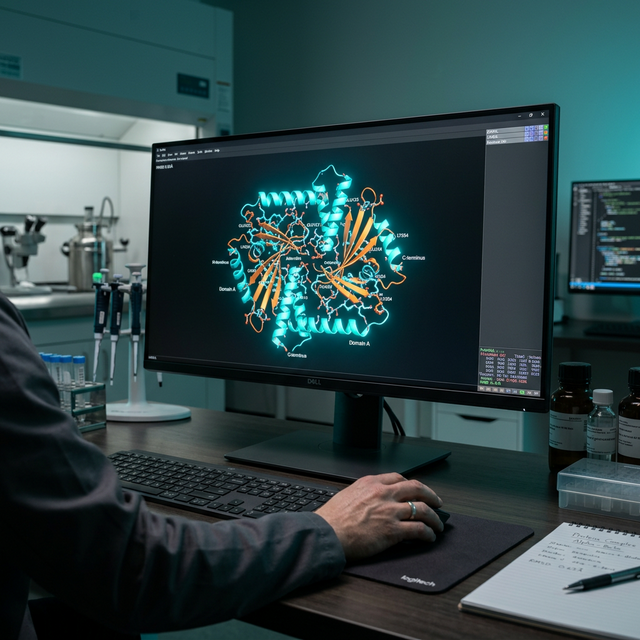
"Data is everywhere, but without the eyes to interpret it, it's just numbers." From a perspective of handling data for a long time at the boundary of IT and science, the AlphaFold Protein Structure Database (AlphaFold DB) released by DeepMind is the largest treasure trove discovered by mankind.
No complex coding or multi-million dollar microscopes are required. A single browser is enough. Based on the research skills learned in parts 1 and 2, I will now reveal the secret of 'practical leveraging', where you can directly see and analyze how the 'protein' you found actually looks.
📋 Practical Table of Contents for Raiding the Data Treasure Trove
- UniProt ID: Secure the 'Social Security Number' of the protein first
- 3D Viewer Interpretation: 'Grade of Trust' indicated by color
- Practical Targeting: How to find the 'valley' where drugs attach
- ❓ FAQ: I'm not a professional researcher, so where do I use this data?
- 🏁 Closing: Tools are equal. The depth of the question makes the difference.
🔍 Technical Deep Dive: Predicted Confidence (pLDDT) and Target Protein Modeling
The 3D models generated by AlphaFold are not just images, but high-precision datasets with tens of thousands of atomic coordinates. Researchers utilize this data to identify the 'Binding Pocket' of disease-causing proteins and design compounds that fit perfectly.
A successful structure analysis and targeting process is as follows:
graph TD
    A["Search UniProt ID and Secure PDB File"] --> B{"Check pLDDT Confidence Score"}
    B -- "Over 90 (Confident Near-structure)" --> C["Surface Electrostatic Potential Analysis"]
    B -- "Under 70 (Uncertainty Exists)" --> D["Exclude Structural Flexibility (Disorder) Sections"]
    C --> E["Explore Druggable Sites"]
    E --> F["In-silico Docking Simulation"]
    F --> G["Derive Final Candidate Substances"]
The most important factor in this process is the pLDDT index. The ability to distinguish whether a protein maintains a fixed form in vivo (blue) or changes its form depending on the situation (orange) determines the success of the analysis.
Experts don't just look at pretty pictures; they read the degree of 'Certainty Spoken by Data' to predict the success probability of actual experiments.
1. UniProt ID: Secure the 'Social Security Number' of the Protein First
Searching by name is for amateurs. This is because you might analyze the wrong protein due to homonyms. You must use the worldwide common ID, 'UniProt ID', to see the facts.
- How to Get: Ask ChatGPT, "Tell me the exact UniProt ID for human secretory insulin." Usually, it gives a 6-digit code like
P01308. - Execution: Enter this ID into the AlphaFold DB search box. This is the most accurate starting point.
2. 3D Viewer Interpretation: 'Grade of Trust' Indicated by Color
The vibrant colors of the 3D model on the screen are not for decoration. It is the 'Confidence Index (pLDDT)' that shows how certain AlphaFold is about the structure it predicted.
- Dark Blue (Over 90): Facts. This is a fixed structure that almost perfectly matches experimental results.
- Light Blue (70~90): A sufficiently reliable form.
- Yellow/Orange (Under 70): Sections where the structure is unstable or fluttering like a tail.
If you are looking for a 'binding site' for disease treatment, you should target the dark blue sections where the framework is solid.
3. Practical Targeting: How to Find the 'Valley' where Drugs Attach
The Sequence (Amino Acid Sequence) window at the bottom of the AlphaFold DB and the viewer at the top are linked.
- Practical Tip: If you obtained information during the research phase that the "150th site is the core target," click 150 in the sequence window at the bottom. The corresponding site will be highlighted in the 3D viewer.
- Insight: Is this site exposed on the protein surface? Or is it deeply hidden? If it protrudes on the surface, it's a 'good target (Druggable target)' where drugs can easily attach. A single piece of data like this determines the direction of the business.
❓ FAQ: I'm Not a Professional Researcher, So Where Do I Use This Data?
Q1. What's the point of me, a layperson, looking at protein structures? A: It's training to increase the resolution of your knowledge. You will gain the insight to directly verify the principles of the latest bio news, cosmetic ingredients, or supplements through 'data' rather than someone else's words. This insight soon becomes information power that makes money.
Q2. Where can I view the PDB files if I download them? A: Use free tools like PyMOL or ChimeraX. You can directly perform the vibrant modeling and simulations you saw in research labs in movies right on your laptop.
Q3. Can AlphaFold's predictions be wrong? A: Yes, which is why you should look closely at the orange (low confidence) sections. Don't forget that AI is not a perfect god, but a tool that visualizes the 'hypothesis' with the highest probability.
🏁 Closing: Tools are Equal. The Depth of the Question Makes the Difference.
Through this series, I have proven that 'practical AI research for the general public' is not a delusion.
What I have realized while visiting many fields is that technology is not the exclusive property of top experts, but the 'weapon of those who ask questions most desperately.' Now the tools are in your hands. Ask questions that no one else has asked and verify them with data. Results are proven by performance.
#AlphaFold #AlphaFoldDB #ProteinStructure #DeepMind #PracticalResearch #SoloScientist #DataAnalysis #ITInsight #TechTrend2026 #FutureTech